
Chrissie Iles, the Anne and Joel Ehrenkranz Curator at the Whitney Museum of American Art, spoke about pioneering American artist Joan Jonas and the arc of her work on the occasion of the U.S. premiere of Jonas’ commission for the 2015 Venice Biennale, “They Come to Us without a Word.”
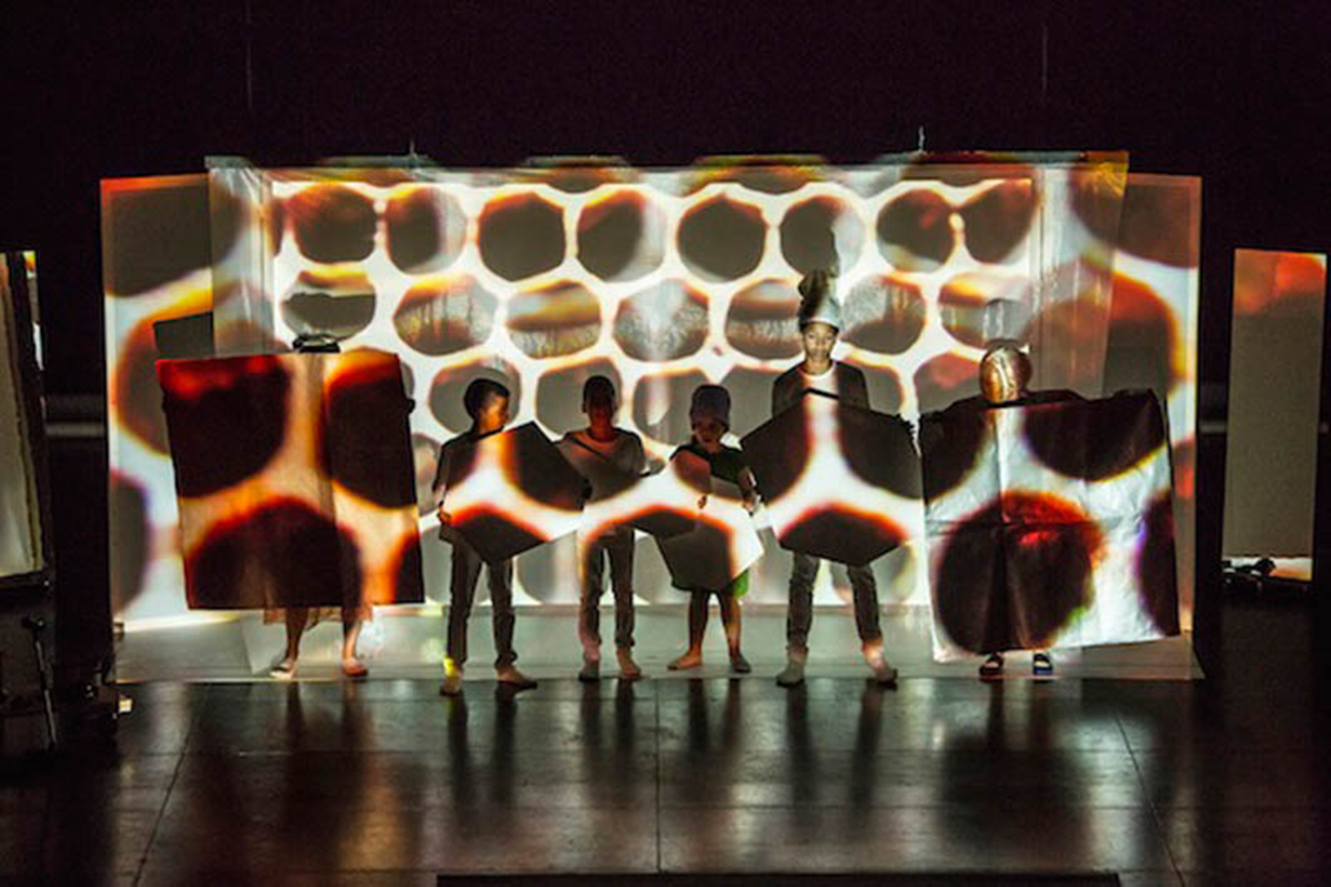
Joan Jonas, They Come to Us without a Word II, performance, Venice Biennale, 2015.
Each of Joan’s works encompasses elements of drawing, performance, installation, sculpture, video, sound, objects, and storytelling that all co-exist in relation to each other, spatially, conceptually, and also across time: elements from one work frequently appear in another, sometimes forty years later. The artist Liam Gillick described the central importance of performance in this approach in a recent interview — “[Y]ou are editing in real time…chopping and cutting, breaking and interrupting.” — to which Joan replied: “ [I am] interested in revealing the process…. I am showing you how I make it… [It’s] related to Surrealism and juxtaposing disparate ideas, objects and images.”(i)
The narrative structure of Joan’s work also evokes the literary influence of Magic Realism, in which the real and the present mix fluidly with the fantastical and the surreal. In They Came to Us Without a Word, we are taken through five rooms, each of which has two videos: one addressing the main motif of the room, the other a fragment of a second, ghost narrative that runs through all the spaces, picking up from the previous room and taking us forward into the next.
Layered onto this double narrative is an immersive collage of drawings, objects, sculptural forms and mirrored surfaces in arrangements that resist easy definition. We are not looking at the traces of a performance that has happened, even though a performance has taken place in parallel to this work, and props, objects, and video footage from that performance are present. And we are not looking at a stage set, nor an installation in the conventional sense of the term, even though the structure of each room resembles both. The space is, to use Jens Schröter’s term, transplanar (ii): a multi-planar surface that opens up the optical border between two and three-dimensional space, creating an environment that can become a portal into new readings of narrative, space, identity, and time.
This haptic structure was first formed by Joan in the cybernetic environment that emerged in the 1960s, and it is one of the many reasons why Joan’s work remains so resonant now, in the deep interconnectedness of our all-surrounding digital environment. As Matthew Biro observed of that period, “To view human beings as cybernetic systems was… to recognize their collaborative nature…subject to constant dispersal, transformation, and exchange.”(iii)
It is important to understand this, in order to put into context the central importance of myth, symbols, ancient ritual, and literature in Joan’s work. It has a feminist, cybernetic aspect that underpins her interest in writers and thinkers such as Aby Warburg and his “denkraum” (“space of thinking”), the labyrinthine spaces of Jorge Luis Borges, or the writings of George Kubler, whose book The Shape of Time pointed out that we understand history through its material traces, since temporal expression – talking, dance, song, music, ritual – have not, by their very nature, survived, except in the re-telling. Joan juxtaposes the material and the temporal in ways that profoundly understand this conundrum, and the importance of experience, memory, and what cannot be recorded or recalled, in the construction of meaning.
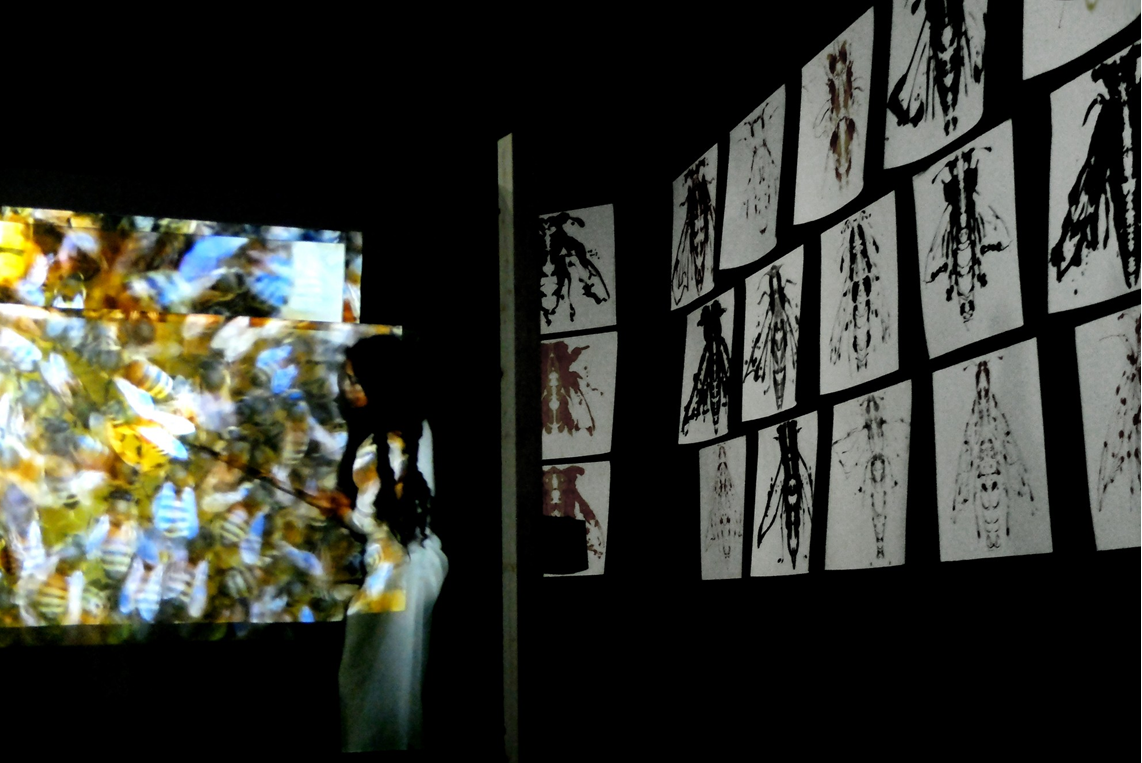
Joan Jonas, They Come to Us without a Word, installation view of Bee Room, 2019.
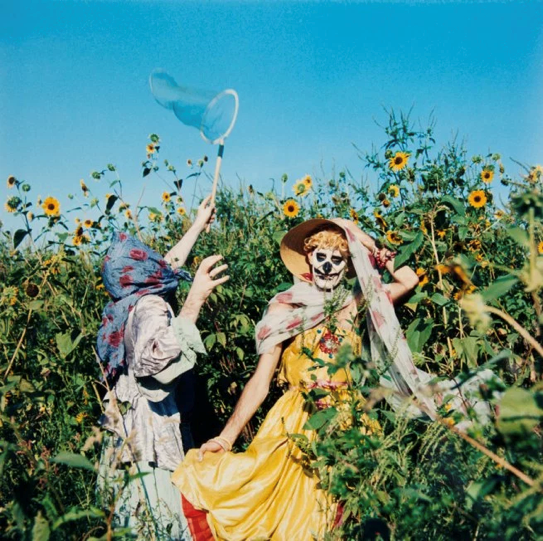
Jack Smith, circa 1958, reprinted in 2011. Photograph by Jack Smith Archive / Courtesy Gladstone Gallery.

(L) Joan Jonas, Organic Honey’s Visual Telepathy, poster (never produced), 1972. Image by Richard Serra. (R) Joan Jonas, Organic Honey’s Vertical Roll, performance at Musee Galliera, Paris, 1972-73. Courtesy of the artist.
Bees, and their anthropomorphic symbolism as bee-women, figure prominently in prehistoric Greek ritual and myth, as goddesses, supernatural beings, and symbols of female power. Two small gold plaques from the seventh century BC, each embossed with a winged Bee goddess, were recently found at Camiros in Rhodes. Priestesses worshipping Artemis and Demeter were called ‘bees’, and recent scholarship has revealed the strong possibility that women wore bee costumes in rituals and mummery during this period, and danced in clusters resembling a swarm.
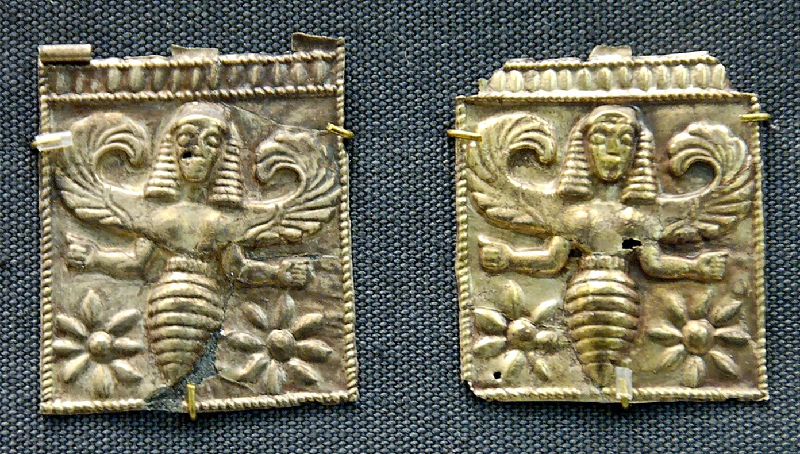
Plaque with bee goddess, rectangular gold plaque, repoussé technique. The “Bee Artemis.” Piece broken from lower edge, Greece, Rhodes, Kameiros, 640-630 B.C.

Joan Jonas, They Come to Us without a Word, installation at CCA Kitakyushu Project Gallery, Kitakyushu, Japan, 2013. Photograph by Kenji Miura.
The dialogue between the internal world of myth, storytelling and symbolic space and the external natural world in Joan’s work has, since the beginning, been articulated through the presence of the body and its mediation by the mirror. As Bruce Ferguson has observed, Joan uses the mirror “not to reify the structuralist moment (where nature and culture…were interchanged in a systematic and masculinist manner [as in the work of Robert] Smithson. . .[Michael] Heizer [and others]. . .and where indices were transferred but never transformed) but instead, to examine its transitional spaces.”(vii) In other words, the mirror operates here as a tool for altering our perception of the space between the natural world and the self.
This in-between space is a subjective, psychologically charged space. In the Mirror room, it is articulated in a haptic, optical form by a group of large silvered panels leaning against the walls, whose cloudy surfaces soften our reflection, and that of the space, into an opaque image. The stark contrast between its dreamlike opacity and the sharpness of the two digital videos and a Venetian glass chandelier inside it, reverses conventions of how reality and fiction are optically understood, rendering impossible the notion of a single, fixed spatial reality.
This contrast between sharpness and opacity, stillness and movement, performative actions and objects, and between different registers of time is built through a complex process of layering. As Joan herself observed, “My idea of layering came when I began to work with different spaces of perception. For instance, by using a large mirror in a performance as a prop carried by the performer, one could see the real image of the performer simultaneously with reflections in the mirror moving in space. At the same time [that] I was doing my outdoor works in the landscape, I was working with perception of movement and forms in the distance and at different intervals from the audience. Then in my video performance, in which the audience saw simultaneously the live performance with a detail of that live performance projected, I began to think of juxtaposing different images and time sequences. These examples were obvious layerings in space.”(viii)
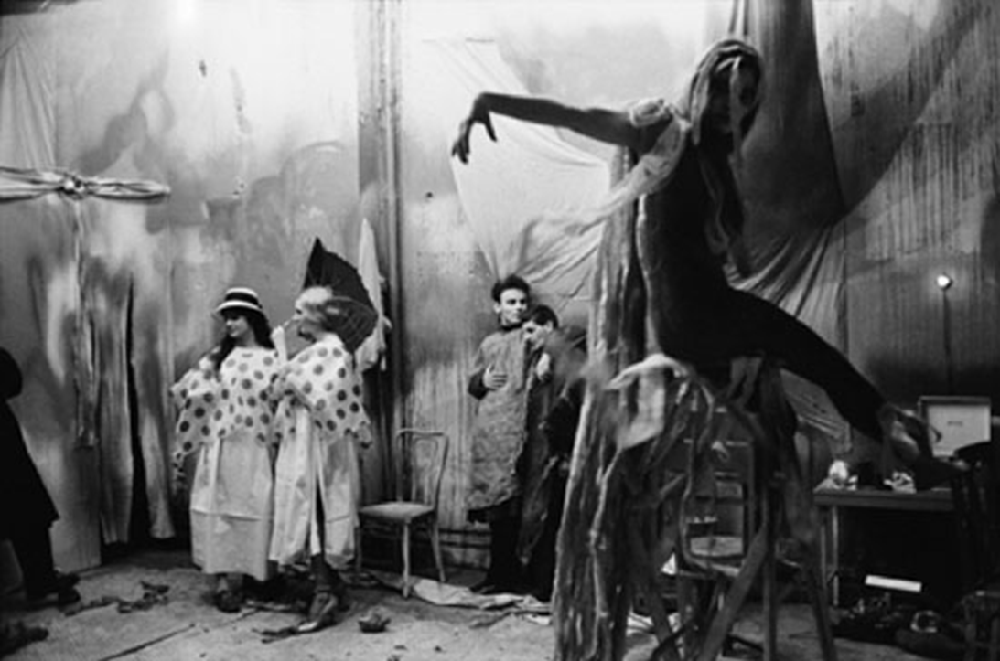
Pat Oldenburg (far right) and others in Claes Oldenburg’s Circus: Ironworks/Fotodeath at the Reuben Gallery, February 1961. © Robert R. McElroy/Licensed by VAGA, New York, New York.
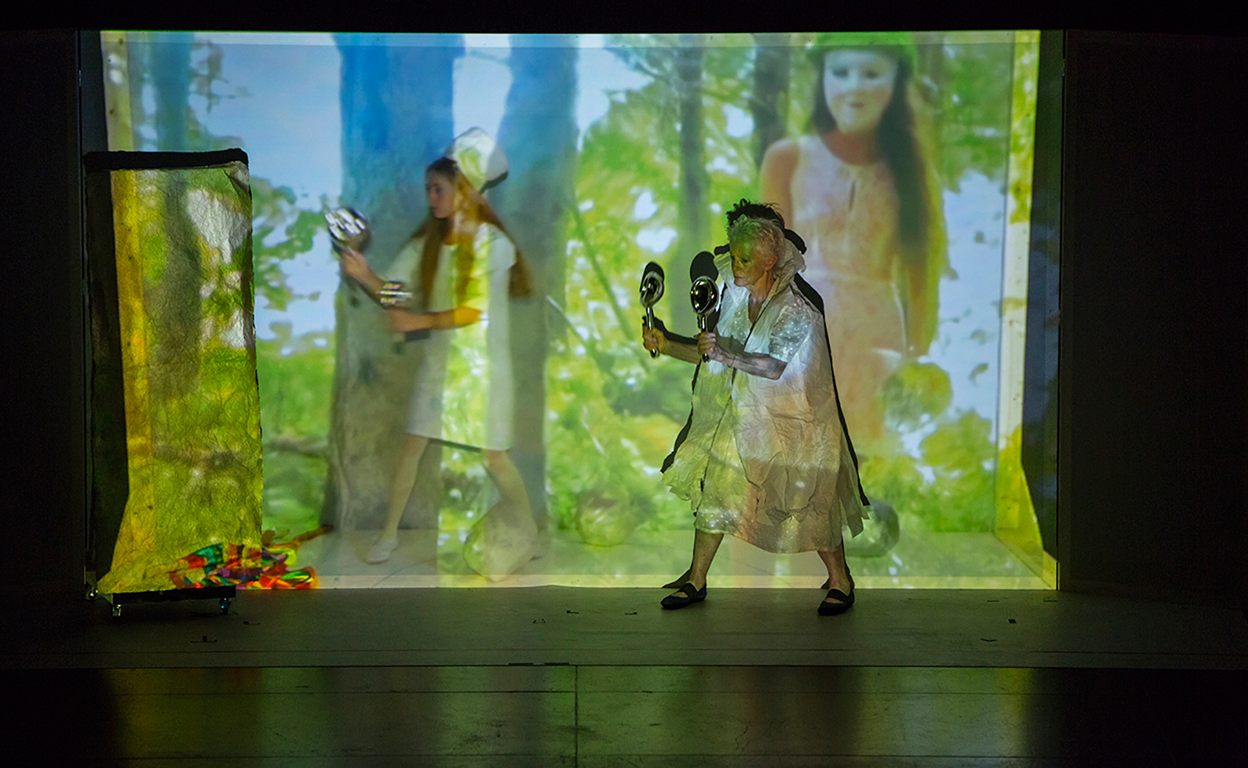
Joan Jonas. Performance documentation of They Come to Us without a Word II, U.S. Pavilion, 56th Venice Biennale, 2015. Photograph by Moira Ricci. Image courtesy of the artist and Gavin Brown’s Enterprise.

Joan Jonas, film still from Wind, 1968. Photography courtesy of the artist.
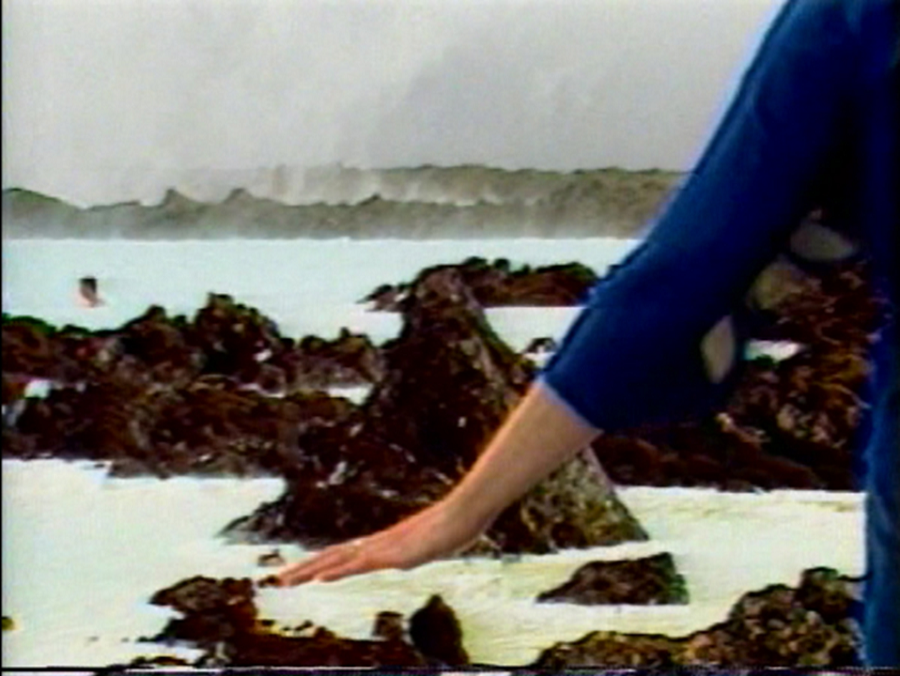
Joan Jonas, film still from Volcano Saga, 1989.
In an era defined by technological and political obfuscation, racial discrimination and violence, preparations for inter-galactic migration, and the irreversible crisis of climate change, Joan’s work has the quality of both a mirror held up to what is happening around us, and a potential model for new ways of thinking. The generative power of her approach can be seen in the work of a new generation of artists including Allison Janae Hamilton, whose video installation Floridaland (2017) addresses racial and ecological issues in the history of the South through storytelling, personal history, and myth. In the video, women in animal masks move through the forests, swamps and agricultural land of North Florida and Western Tennessee, a landscape dominated by the history of slavery, white power, exploitation, and hierarchies of race and class. The historical resistance of the communities, including Hamilton’s farming family (the women in the videos are the artist, her mother, and her godmother) appear in images evoking mystical references from Hoodoo — the knowledge of rural black healers — and the surrounding landscape. The sound of birds, insects, and percussion create an atmosphere of anxiety, not only about the land’s traumatic past but also about its future, through the looming consequences of climate change, and in particular hurricanes, which impact disproportionately high numbers of the black community in the South.

Allison Janae Hamilton, film still from The Land of Milk or Honey, 2016.
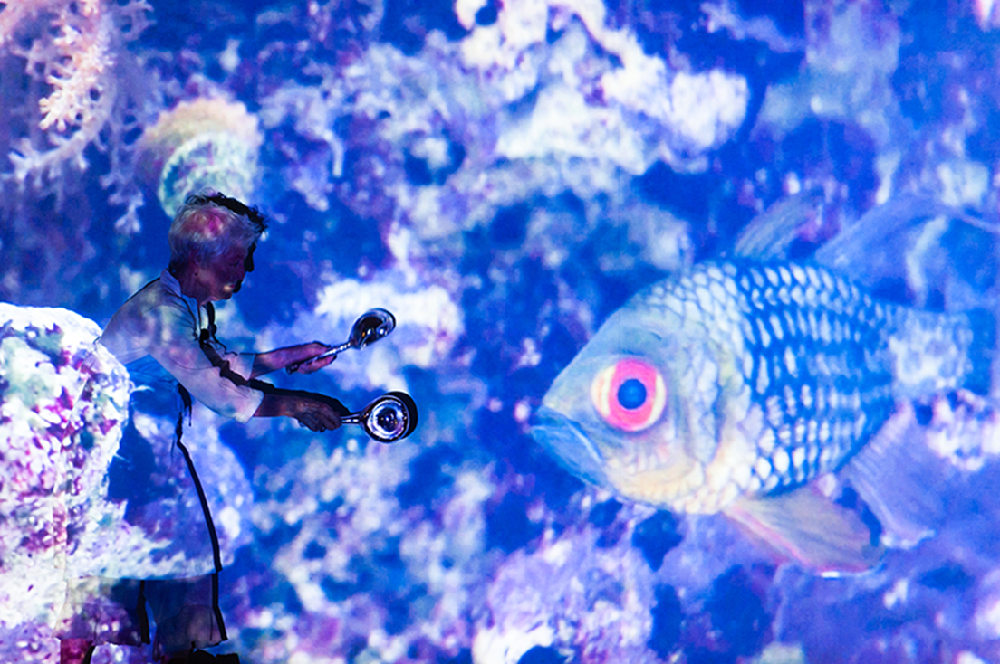
Joan Jonas, Moving Off the Land. Courtesy the artist and Gavin Brown’s Enterprise, New York/Rome.
That Carson’s words should reappear in Joan’s thinking, forty years after they were written and read by the artist and countless others, underlines the acceleration of their urgency. Her warning evokes Shakespeare’s words from “Ariel’s Song” in The Tempest: “Full fathom five thy father lies/of his bones are coral made/those are pearls that were his eyes/nothing of him that doth fade/but doth suffer a sea-change/into something rich and strange.”(xi) This description of a return to the sea from whence we all came is a death song; yet the sea is also symbolic of the unconscious, and the maternal body. In Moving off the Land, the sea is teeming with intelligent life, suggesting that its fate and ours are inextricably linked. It is in the implications of this that we can, perhaps, learn how to prepare to live in the future.
Chrissie Iles
Anne and Joel Ehrenkranz Curator
Whitney Museum of American Art
Footnotes:
i ‘Joan Jonas’, Liam Gillick, interview with Joan Jonas, Art Review, March 2018
ii Jens Schröter, 3D: History, Theory and Aesthetics of the Transplane Image. London: Bloomsbury Academic, 2014.
iii Matthew Biro, The Dada Cyborg: Visions of the New Human in Weimar Berlin. Minnesota: University of Minnesota Press, 2009, p. 3.
iv “Drawing My Way In: Joan Jonas in Conversation with Bonnie Marranca and Claire MacDonald”, Performing Arts Journal 107, Vol. 36, May 2014, pp.45-46
v Carlos Basualdo, “Life on the Mirror’s Edge.” Mirror’s Edge (exh. cat.), Bildmuseet, Umeå 1999, p. 33
vi A unit of radioactivity
vii “AmerefierycontemplationonthesagaofJoanJonas”, Bruce Ferguson, Joan Jonas, (exh. cat.), Stedelijk Museum Amsterdam 1993, p. 18.
viii “Drawing My Way In” op.cit., p.40.
ix Halldór Laxness, Under the Glacier, 2007, Knopf Doubleday Publishing Group, pp.78-79.
x Rachel Carson, The Sea Around Us, Oxford University Press, 1951
xi William Shakespeare, “Ariel’s Song,” in The Tempest, Act I, Scene ii, 1610